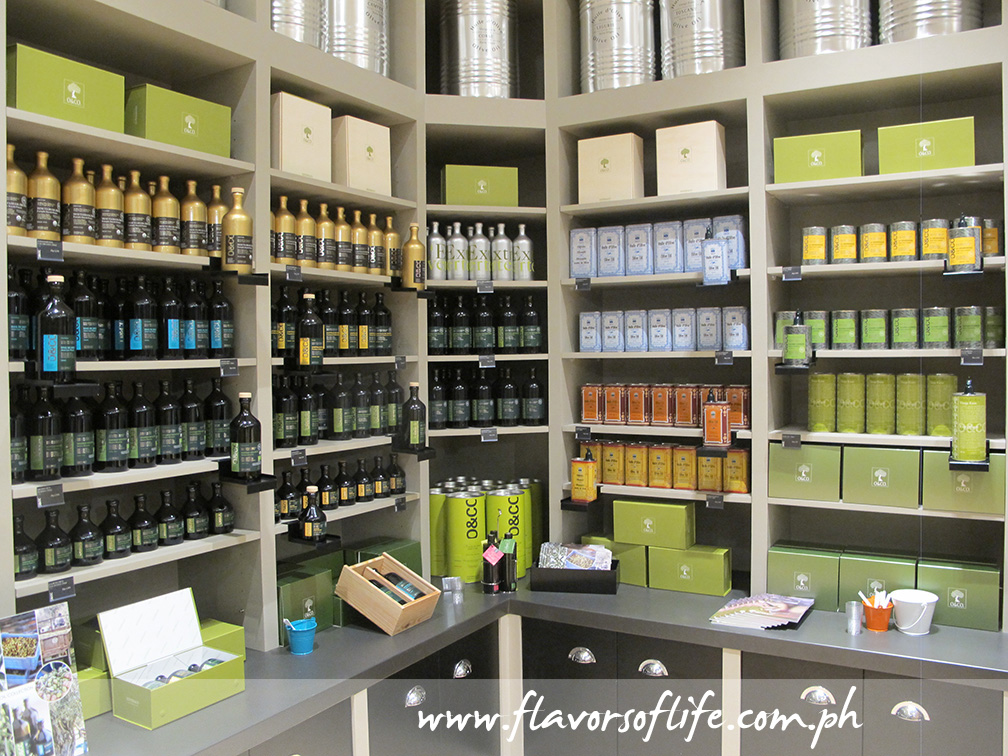
OLIVE oil is one of the healthiest types of oil available in the market today. We use its different variants for different cooking needs – Extra Virgin Olive Oil for drizzling into salad dressings, Pure Olive Oil for sauteeing and stir-frying, and Pomace for frying. More than these variants, however, flavored and herb-infused olive oils have made it to the shelves of gourmet delis, health shops and major supermarkets. Now comes a whole line of luxury olive oils made by pressing olives and other ingredients together in the process of producing olive oil so that the flavors are strong and intrinsic in the oil. It’s called Oliviers & Co., and it’s now in Manila.
Stores Specialists Inc., a member of The SSI Group, which is one of the country’s leading specialty retailers, has brought Oliviers & Co. to the metro and opened its first store at the Central Square in Bonifacio High Street Central recently. The French-based company is renowned for its collection of gourmet olive oils, seasonings, and condiments developed using the best ingredients and top-notch processes. With 300 partner mills in France, Italy, Spain, Croatia, Greece and Portugal all committed to producing oil of superior quality, Oliviers & Co. is able to acquire only the best of the lot, and so its oil is revered by the world’s most acclaimed chefs. For 18 years, the company has staked its name on traceability and reliability, producing quality oils through watchful preparation. Each type of oil, which must strictly come from a single orchard, has its own specialized bottle or can, and on the label is written the place of origin (country and region), harvest date, tree variety and exact proportions of the components, which is even more stringent than the specifications written on the label of a bottle of wine.
Oliviers & Co.’s first Philippine store is now open at the Central Square at Bonifacio High Street Central
Part of the product display
Oliviers & Co.’s sales director Melanie Costaris-Novais and Oliviers & Co. Asia Pte Ltd,s general manager for Asia Pacific May Tan flanking Black Sheep’s Chef Jordy Navarro
Oliviers & Co.’s first oils were sourced from families and small cooperatives, and each type had its own story – from French immigrants planting olive trees in the 1950s to Lebanon’s widowed first lady asking company owner and CEO Albert Baussan for his help to modernize her country’s olive oil production. However, it was in 1998, with the arrival of sensory specialist and analyst Eric Verdier, that the brand solidified its reputation of imperturbable consistency and innovative product development. As Oliviers & Co.’s custodian of excellence, he implemented an extremely demanding criteria to ensure quality befitting the brand’s rich history and name – and he personally inspects everything to make sure it is all up to par. As in wine-making, Verdier tastes all the oils, and only the best pass his impeccable taste standard.
Though precision is repeated with every one of Oliviers & Co.’s mills, each mill is free to concoct its own local profiles. Master chefs around the world, such as Eric Frechon, Alain Passard, Michel Roth and Gerald Passedat have also contributed to the brand’s extensive variety. The company has an entire catalogue of vintage olive oils, rare allocations and grand crus. While its main product line consists of olive oils of high quality issued from selected orchards, Olivers & Co. has also expanded to include other luxury products, such as vinegars and condiments with original flavors, sweet and salted Mediterranean delights, plus a range of cosmetic products based on olive oil.
Basil Olive Oil
Gift Pack
Balsamic Condiment
Garlic Olive Oil
Fig and Melon Vanilla-Star Aniseed Fruit Spread
Extra Virgin Olive Oil cold extraction
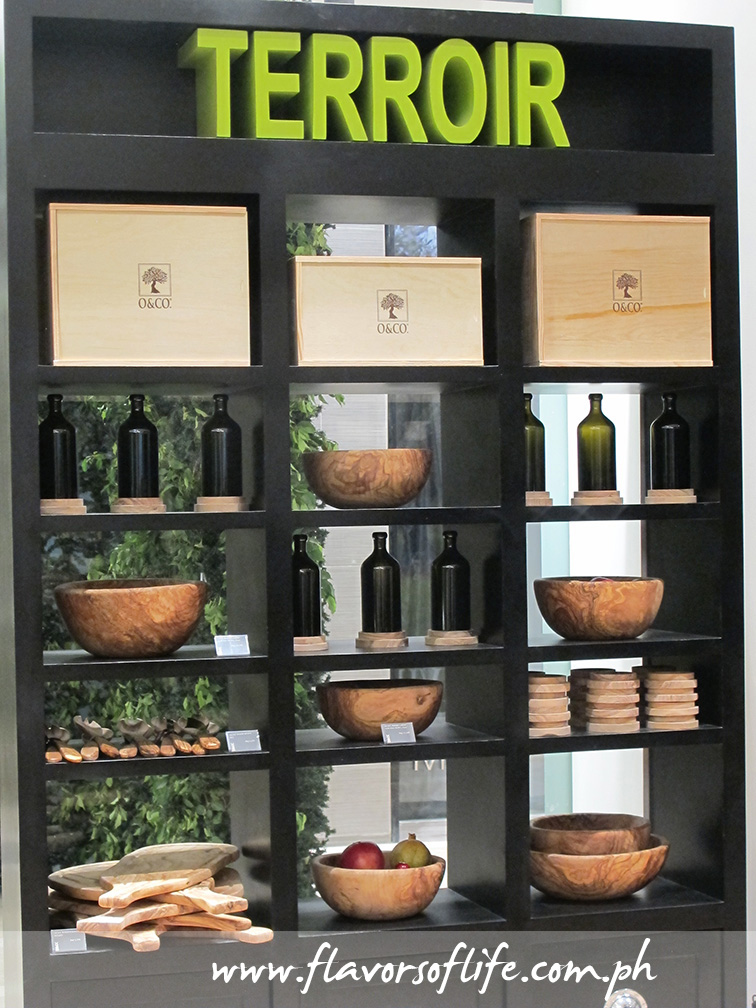
Special items such as exquisite wooden chopping boards, mixing bowls, salad spoon and fork combinations, and bottle rest are also available
Raspberry Wine Vinegar
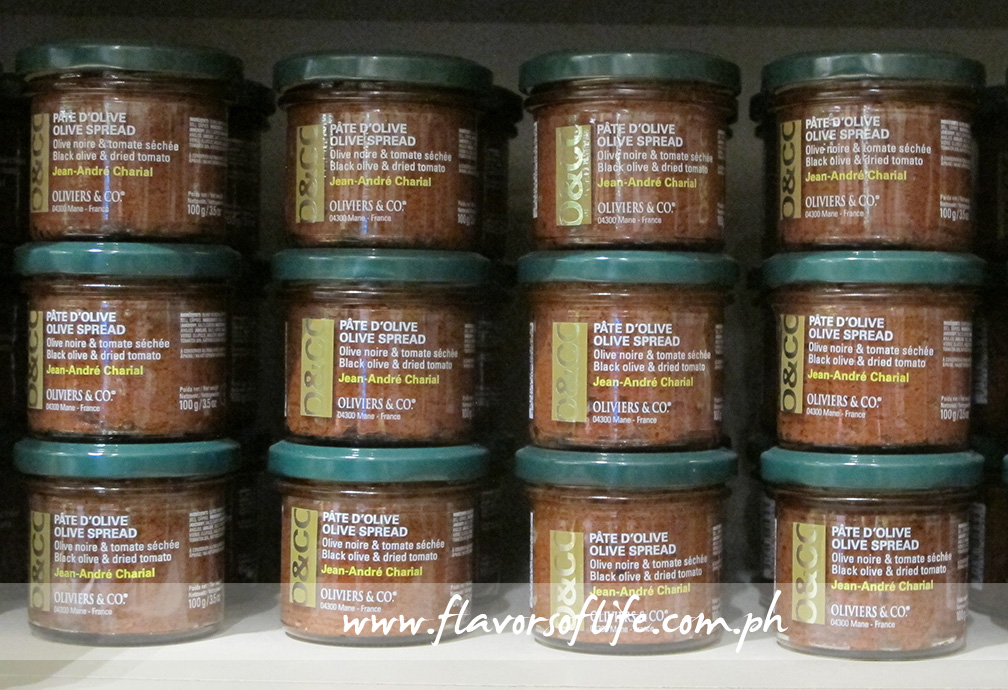
Black Olive and Dried Tomato Spread
Limited Edition Balsamic Vinegar
At the Oliviers & Co. store recently opened in Bonifacio Global City, all these signature products are available off the rack, and guests are encouraged to actually taste the products to see which ones they really like. Recipe cards are also provided for the taking to guide customers on how to best use the products. Other rare items, such as wooden chopping boards, bowls, spoon and fork combinations, and bottle rests, are also available. So, if you feel like cooking with truffle oil or dipping your bread in a basil olive oil and in a balsamic vinegar condiment, you know where to get them.
(Oliviers & Co. is located at Level 2 of Central Square, Bonifacio High Street Central, 5th Ave. corner 30th St., Bonifacio Global City, Taguig City; with telephone number 950-8211. It is open from Sundays to Thursdays, from 11:00 a.m. to 10:00 p.m., and from Fridays to Saturdays from 11:00 a.m. to 11:00 p.m.)
Congresswoman Leni Robredo and Multiple Intelligence School student Daniel ‘Chip’ Gatmaytan both want schools to ban softdrinks and provide healthier drink alternatives to students
THE figures are alarming: The rate of obesity among children in the Philippines has gone up from 3.2% in 2012 to 4.9% in 2013, and the prevalence rate of overweight children in the country for children aged 0 to 5 has increased from 0.4% to 1.4% and for children aged 6 to 10 from negligible to 1.3%. This is mainly due to the passive lifestyle that Filipino children now lead, indulging in computer games and lacking in physical activity and the intake of not just chips and highly processed food but also softdrinks and other sugary artificially flavored drinks. Not surprisingly, this kind of lifestyle has also led to earlier occurrences of lifestyle diseases, such as diabetes, in Filipinos.
But how can you, for instance, curb your children’s addiction to soda when it’s what’s conveniently available in their school canteens? Fortunately, there’s one 10-year-old Filipino kid named Daniel ‘Chip’ Gatmaytan, a Grade 5 student of the Multiple Intelligence School, who has actively taken up the cause of having softdrinks banned in kindergarten, elementary and high schools and requiring schools to provide healthier beverage options such as mineral water and fruit-based drinks for their students. Chip, whose dad is a lawyer and whose mom is an economist, has taken his Grade 1 school project a notch higher, campaigning vigorously to make kids aware of the softdrink malady and to make adults take action against it. Three years ago, specifically in 2011, Chip hogged headlines when he went to Congress with his proposed bill, and some legislators took heed and took up his cause, with House and Senate bills titled Healthy Beverage Options Act, filed in both houses. While both efforts failed to reach the Plenary before the 15th Congress adjourned, its proponents, including Congresswoman Maria Leonor ‘Leni’ Gerona-Robredo, are trying their best to get legislation for it in the 16th Congress.
Congresswoman Leni Robredo and young Chip Gatmaytan were both special guests in a recent juice party put together by Fly Ace Corporation at Annabel’s Restaurant in Quezon City to support Healthy Beverage Options Act 4021. Fly Ace Corporation, exclusive Philippine distributor of such juice brands as Old Orchard, Welch’s, Mott’s, Happy Day and Jolly Fresh Juice, hosted the first beverage fete as part of its effort to educate Filipinos on the benefits of drinking 100% fruit juice.
At the Juice Party hosted by Fly Ace Corporation, from left: marketing manager Teresa Conda, product manager Jasmine Capule, Congresswoman Leni Robredo, president Jun Cochanco, and EVP for sales and marketing Larry Cochanco
The juice party advocated the consumption of 100% fruit juices, as they contain more vitamins and minerals than fruit drinks, sweetened teas and carbonated drinks. Congresswoman Leni Robredo, representative of the Third District of Camarines Sur and co-author of the Healthy Beverage Options Act 4021 of the Philippines along with Dinagat Islands Re. Arlene ‘Kaka’ Bag-ao, served as guest speaker, and in her speech, she acknowledged and introduced Chip, lauding his youthful efforts against the excessive consumption of sodas especially among school-age children.
Serving as resource person was Professor Luchie Callanta, RND, MSN.
THE BENEFITS OF DRINKING HEALTHY JUICES
Juice brands carried by Fly Ace Corporation
Professor Luchie Callanta, RND, MSN
Professor Luchie gave a short but very informative talk on the benefits of drinking healthy 100% juice. She is credited for having drawn the inverted Drink Pyramid, which identifies which drinks are essential and for daily consumption, those that must be consumed regularly and those that are to be consumed sparingly. On top of the inverted pyramid and identified as essential fluid intakes for daily consumption are water, mineral water and milk. In the middle are fruit juices and fruit nectars, which are to be consumed regularly; while those which must only be consumed sparingly are diet drinks, lemonades, energy drinks and carbonated drinks.
Teresa Conda, marketing manager of Fly Ace Corporation, stressed that there are three types of fruit juices: 100% Juice, Nectars and Fruit Drinks. 100% Juice refers to juices that have 100% real fruit content, are the direct juice from fruits, and therefore retain their original aroma, color, vitamins and minerals and have no sugar and additives. Nectars contain 25 to 50% fruit juice content, with additional water, sweeteners such as honey, corn syrup, sugar and citric acid, are made from very expensive fruits that are either too sour or too thick, such as cranberry, passion fruit, peach and mango. Fruit drinks contain a small proportion of fruit juice and are made up mostly of water, sugar additives such as citric acid, artificial flavors, colorants and stabilizers. Fly Ace Corporation’s ready to drink brands, such as Rauch, Happy Day, Old Orchard, Mott’s, Welch’s and Jolly Fresh, offer mostly 100% Juice and Nectar variants.
THE 5-A-DAY RULE
In her talk, Professor Luchie emphasized that the human body needs to get a regular dose of antioxidants every day to protect it from free radicals which damage body cells and tissues and cause lowered immunity that eventually leads to diseases.
“Free radicals are brought about by exposure to harmful air pollution, radiation, contaminants and stress, plus the highly processed food that we eat, so we need to protect ourselves from the harmful rays of the sun, get a regular dose of the positive stress that we all have to have every day, which is exercise, and consume 5 to 9 servings of antioxidant-rich fruits and vegetables every day,” says Professor Luchie.
For the latter, she recommended “painting” one’s daily diet as colorfully as possible. Important colors include Orange and Deep Yellow (which one can get from vegetables like squash), Deep Orange (oranges), Red (tomato, watermelon, apple, cranberry), Light Green (leeks, cabbage), Dark Green (spinach, Romaine lettuce, pechay, camote tops), and Purple and Dark Blue (eggplant, blueberry, grapes, red-skinned potatoes, plums).
If you cannot eat all of it, then you can drink some of it – especially since the recommended daily consumption of water is no longer just eight glasses of water but 2.8 liters of water and juices for women and 3 to 3.2 liters for men.
Drinks made with Fly Ace Corporation juice brands during the Juice Party, clockwise from top: Cosmopolitan, Fruit Cocktail Punch and Apple Citrus Cooler
Good choices among readily available fruits and juices are Oranges, Apple, Grapes, Cranberry and Plums/Prunes.
• Oranges – lower blood pressure because of their flavonoid and hesperidin ,content; lower the incidence of peptic ulcers since oranges, despite being considered acidic, have an alkaline effect in the stomach; strengthen the immune system due to their Vitamin C content; fight cancer because of the phytochemical limonoid; stimulate digestive juices; and fight aging.
• Apple – helps to control asthma; protects bones due to flavonoids and the mineral boron; prevents cancer, strengthens mental health and prevents Alzheimer’s Disease; aids in digestion because it’s fiber-rich; and lowers cholesterol.
• Grapes – lower cholesterol and blood pressure; and are rich in antioxidants, particularly resveratrol.
• Cranberry – rids infection in the urinary tract; contains natural antioxidants, particularly Vitamin C; boosts High Density Lipoprotein (HDL) or good cholesterol by an average of 7%; promotes mental health by getting rid of anxiety and stress and improving memory; relieves skin conditions; builds immune system and particularly strengthens the respiratory system; and contains beneficial flavonoids, anthocyanins and phenols.
• Plums/ Prunes – protect the gastrointestinal tract; regulate blood sugar levels; are high in fiber; and are beneficial to heart health.
TRUTH HURTS
Unfortunately, while fruits are in great abundance throughout the country, the Philippines is a nation of soda drinkers, as influenced by the fast-food lifestyle, and it would take legislation to force school canteens, for one, to stop serving convenient softdrinks and start offering healthier alternatives.
When the Healthy Beverage Options Act is passed, softdrinks would be banned from all kindergarten, elementary and high schools. Sports drinks, punches, iced tea and fruit drinks would also be banned. It should force schools to provide healthier beverage options for children, such as fruit based drinks that contain at least 50% juice and no additional sweeteners, water and seltzers, and low-fat or fat-free dairy or non-dairy calcium-fortified milk.
Congresswoman Leni is the first to admit that the bill is facing tough challenges, with lots of entities lobbying against it in the interest of business, but she and other proponents of the House and Senate versions of the bill are hell-bent on getting it passed to give Filipino school children a healthier and better future.
Balatinao and Imelda Biko served by PhilRice’s Isabela Branch
THERE is another version of the traditional blood stew dish dinuguan in Isabela besides Barangay Captain Rodolfo dela Cruz’s Siniwsiwan, and it’s called Serkele. Popular in the Northeastern province of Isabela, Serkele is enjoyed by the common people, as it is readily available in roadside eateries. For a taste of good Serkele, they often go to restaurants and eateries that specialize in it, such as Aling Luring’s Gotohan and Serkele in Cauayan City. So that’s where our media group – me and my husband Raff, Angelo Comsti, Ige Ramos, Nana Caragay, Tata Mapa, Paul Jeffric del Rosario and Pam Santos – went for breakfast on Day 3 of our four-day Isabela food tour last May (2014).
Aling Luring’s Gotohan and Serkele
The simple, wood-dominated interiors of Aling Luring’s Gotohan and Serkele
Serkele is Isabela’s version of the blood stew, dinuguan
Goto
Regular Pancit Palabok with crushed chicharon topping
Pancit Palabok with crispy tofu topping
Okoy
Fried Lumpia
Aside from Serkele, which is best paired with Puto, other simple but satisfyingdishes that we tried at Aling Luring’s for breakfast included Goto, Pancit Palabok (the crushed chicharon or crispy pork rind sprinkled on top of the noodle dish can be replaced with crispy tofu bits if you don’t want the chicharon), Okoy and Fried Lumpia.
Aling Luring’s place is simple, with walls, windows and stools made of wood, and the dining setup is typical of a turo-turo restaurant. It’s clean and orderly, and the food is affordable and good. Nothing fancy, no pretenses.
GETTING ACQUAINTED WITH FROGS
From Aling Luring’s Gotohan and Serkele, the service van took us to Cauayan Public Market upon the group’s request, as we wanted to check out the produce and see if there were things we could find that were unique to Isabela. We dropped in on Aling Belen Recometa Holgado, who’s popular for her delicious longganisa, in her stall in the wet market as we went around, and she was so happy to see us. As with other wet markets that we have visited in different parts of the country, the Cauayan Public Market showcased the bountiful produce of the country. Frogs were perhaps the only unique merchandise we saw in the Cauayan Public Market. These edible frogs were dead, of course, and skinned to make them ready to cook, and were sold alongside tilapia fish.
Cauayan Public Market
A variety of dried fish available in the market
Aling Belen’s longganisa stall
Skinned frogs for sale in the market
Adobong Palaka cooked by the kitchen staff of Isabela Governor Bojie Dy
From the market, we went straight to house of Isabela Governor Bojie Dy in Cauayan City. We watched the Governor’s staff cook Adobong Palaka in the kitchen and we got to try it afterwards. It’s the most exotic dish that we tried during our Isabela food tour, but, for me, it wasn’t so exotic at all. I had eaten frog as a child on summer vacation in my mom’s hometown of Tayug, Pangasinan, so I had no qualms about eating frog. Raff, though, wouldn’t touch it with a ten-foot pole, and it was amusing to watch the reaction of Nana as she bravely picked up a frog and took a bite.
THE HOME OF MORIECOS
Next stop before lunch was at Francing’s Moriecos in Cabatuan. As with other kakanins or native delicacies in Isabela and other provinces, Isabela’s Moriecos was a family backyard industry. Moriecos is a type of suman made with galapong (ground glutinous rice mixed with water) with a latik type sweet filling. The filling, made with coconut milk and brown sugar, is pre-cooked until paste-like and then allowed to cool down before it is wrapped in glutinous rice balls into fat cylinders and then steamed.
Francing’s Moriecos in Cabatuan, Isabela
Felix Recto cooking the filling for the Moriecos
Francing and Felix Recto
Francing Antonio Recto making Moriecos
Moriecos cooking in the steamer
Moriecos ready for delivery
Moriecos!
Credited for having invented the Moriecos was Aling Francing Antonio Recto, whose Moriecos-making backyard we visited. She has been making Moriecos for 25 years now, assisted by her husband Felix Recto, who used to work in Saudi Arabia. They make Moriecos by order and sell them for Php20 per piece, and because it has become a favorite pasalubong item from Isabela, she already has boxes made to pack exact numbers of Moriecos for air or land travel.
Moriecos is good because when you bite into it, you get a well-rounded taste of the suman and the sweet filling inside.
A MONGGO FEAST
From Cabatuan, we proceeded to San Mateo to make a courtesy call on Mayor Crispina Agcaoili and Vice Mayor Roberto Agcaoili at the Municipal Hall of San Mateo. The couple highlighted the importance of monggo (mung beans) in the economy of San Mateo. Considered “the black gold” of San Mateo, monggo is one of the major produce of the agricultural municipality aside from rice and corn. San Mateo is not just the Monggo Capital of the Philippines but also the No. 1 producer of rice in Cagayan Valley, accounting for a significant production of black rice and brown rice. Mayor Agcaoili also proudly announced that San Mateo now produces a lot of monggo products, including monggo flour, monggo grits, monggo noodles, monggo coffee and delicacies like monggo polvoron and monggo chips.
The seal of the Municipal Government of San Mateo rendered in monggo beans
San Mateo Mayor Crispina Agcaoili and Vice Mayor Roberto Agcaoili
Ginisang Munggo
Monggo Buchi
Monggo fields in San Mateo, Isabela
A closer look at the monggo plant
Hitting the long monggo beans with a wooden stick to release the seeds within
Gathering the monggo seeds into a bilao
Swinging the bilao of monggo seeds up and down to remove impurities
Monggo products from San Mateo, Isabela
After a filling lunch of Ginisang Munggo, pancit and Monggo Buchi, the group visited a monggo field by the roadside. Monggo sprouts in long beans on monggo plants, the people there explained, and when the beans turn brown, these beans are harvested. What the monggo farmers of San Mateo do is gather these long beans together by the roadside, release the monggo seeds within by hitting them with a wooden stick. The seeds are then gathered into bilaos to remove parts of the bean skin and other impurities that have been mixed into the monggo seeds.
MAGAT DAM
A quick tour of Magat Dam in Ramon, Isabela, followed. Built in 1982, the huge dam that supplies water for power and irrigation is bordered by Ramon, Isabela on one side, by Nueva Vizcaya on another side, and, finally, by the Municipality of Alfonso Lista in the Province of Ifugao, which belongs to the Cordillera Administrative Region (CAR).
Magat Dam is bordered by Isabela, Ifugao and Nueva Vizcaya
ALL ABOUT RICE
Then we continued on our journey and made a stop at the Philippine Rice Research Institute (PhilRice) office in Barangay Malasin, San Mateo, Isabela. Here, we got acquainted with the different rice varieties grown in the region, including Balatinao (black rice) from Kalinga, Imelda (white glutinous rice) from Nueva Vizcaya, Gallano (red rice) from Ifugao, Pinilisa (black rice) from Jones, Isabela, and other varieties such as Tapuy and Mestizo.
The PhilRice staff was obviously ready for us, since they laid out a merienda spread of Pancit Monggo, and Imelda and Balatinao Biko before us. We gladly obliged.
Rice samples from PhilRice
Improved variety of glutinous rice
Pancit Monggo
Biko made with Balatinao rice and Imelda rice
SIMPLE BUT GOURMET DINNER
Our last eating engagement for the day was dinner at Corlyn Farms sponsored by the Rural Bank of San Mateo (Isabela) Inc., PhilRice (San Mateo, Isabela Branch) and Amancio Dairy & Produce Farm. Dinner was prepared by Isabela-born international chef Cocoy Ventura, and it began with an appetizing dip of homemade bagoong served with Isabela mangoes and cucumber slices on the buffet table.
Sunset at Corlyn Farms
The set-up of the simple but gourmet dinner
The display table teeming with Corlyn Farms’ mangoes, Chef Cocoy Ventura’s mango membrillo in bottles and packs of PhilRice brown rice
Gourmet sugpo salt formed part of the table display
Chef Cocoy Ventura
Dinner turned into a sit-down affair when the courses started coming, starting with Sinampalukang Tahong at Tulya (Green Mussels and River Petite Clams in Tamarind Blossom Broth); Tochong Labahita (surgeonfish with fermented black beans, sweet green chilis and squash); Smoked Tilapia (deep-fried, locally smoked, natural tilapia with tomato and green mango salad) and Calderetang Pato (Amancio free-range Peking duck braised in tomato sauce, liver sauce, pineapple, bell pepper, carrots and olives). A PhilRice Sampler rice platter composed of Mestizo 1, Mestizo 1 Brown, Gallano Red and Pinilisa steamed rice gave us a choice of what type of rice we wanted to enjoy the sumptuous dishes with.
Sinampalukang Tahong at Tulya
Smoked Tilapia with Tomato and Green Mango Salad
Calderetang Pato
PhilRice Sampler
Imelda and Balatinao Puto Maya served with Corlyn Farms’ mangoes
Tamarindo
Dessert came in the form of Imelda and Balatinao Puto Maya served with Corlyn Farms mangoes and mango membrillo as well as Flan de Leche ala Luisa, with Amancio coffee and tea rounding out the dinner. Chef Cocoy’s Tamarindo was such a refreshing way to wash down all the food.
After the memorable dinner in Chef Cocoy’s house, surrounded by sprawling green fields and highlighted by a breath-taking golden sunset, the group headed back for the Governor’s Mansion in Cauayan City. Some members of the media group who were heading back to Manila by land simply freshened up at the Governor’s Mansion and got on the way for the 8-hour ride back to Manila. They were leaving that evening to make it back to Manila by morning the following day; while the rest of us, who were going by plane via Tuguegarao Airport in Cagayan, hit the bed early.
Josie’s Panciteria and Restaurant in Cabagan, Isabela
Pancit Cabagan
The schedule the next day was light. Just a stopover at Josie’s Carinderia and Restaurant in Cabagan, Isabela, for brunch on the ride to Tuguegarao, Cagayan, for our flight back to Manila.
By van or by plane, we all brought home a good amount of Isabela longganisa, Moriecos, Inatata, Binallay, mung beans, pancit monggo, Chef Cocoy Ventura’s mango membrillo and PhilRice brown rice, plus loads of memories of our Isabela food tour that would last a long, long time.
DAY 2 of our Isabela food tour last May (2014) was a full day of nonstop eating. The media group – me and my husband Raff, Angelo Comsti, Ige Ramos, Tata Mapa, Nana Caragay, Paul Jeffric del Rosario and Pam Santos – bonded over food from breakfast to dinner with lots of snacks in between.
The day began with breakfast at Isabela Governor Bojie Dy’s residence in Cauayan City, where we had a buffet of Isabela’s famous longganisa with fried sunny side up eggs, hotdogs and garlic rice set before us. We were still raving about the flavorful and garlicky longganisa when in came Aling Belen Recometa Holgado into the dining room.
LUCRATIVE LONGGANISA BUSINESS
Aling Belen, it turned out, was the brains behind the delicious longganisa that we were raving about. In her typical shrill but animated manner of speaking, which amused us, Aling Belen related that she had been making longganisa in Isabela since 1970. She had just graduated from college then, and she experimented with ingredient combinations before she got the perfect formula for her famous longganisa. She started making small batches of 2 to 3 kilogram longganisas. Business was good and soon she was making 10 to 20 kilograms. Her longganisa, she says, became so popular in the province that people would look for her brand and not settle for anybody else’s. The Dy family was among those who patronized her longganisa and promoted it to friends and guests alike. These days, Governor Bojie Dy would sometimes order 200 to 220 kilograms of longganisa to give away to friends whenever there’s a special occasion.
Aling Belen Recometa Holgado’s longganisa is a breakfast staple in the province of Isabela
Aling Belen Recometa Holgado mixing her famous longganisa
Stuffing cleaned pig’s intestines with the longganisa mixture…
Tying the longganisa into segments
Her longganisa business, Aling Belen proudly stressed, was responsible for sending her six children to school. Her eldest is an electrical engineer, her second finished management and marketing, her third works as an X-ray technician, her fourth helps her out in her longganisa business, her fifth studied Marine Engineering at the Philippine Maritime Institute, and her sixth and youngest took up Hotel and Restaurant Management at the Far Eastern University.
The secret to her longganisa, she said, is the personal touch that she puts into it. She personally picks and purchases the meat that she uses in making her longganisa. She looks for a certain percentage of lean meat and fat ratio in her meat and does not compromise on its quality. She also observes proper hygiene and cleanliness whenever she makes her longganisa and personally grinds it using her own grinder.
She had come over to the Governor’s house that morning not only to deliver the longganisas ordered by Francis Faustino ‘Kiko’ Dy, the eldest son of Governor Bojie Dy, barangay captain of San Fabian, Echague, Isabela, president of the Association of Barangay Captains (ABC) in the province, and our media group’s host for our four-day Isabela food tour. She was also asked to conduct a demo on how she makes her longganisa for the group to photograph, and she obliged.
So we settled in the garden after breakfast and she did the demo there. Besides quality meat, Aling Belen also added other flavorful ingredients into her longganisa, including garlic, soy sauce, salt, pepper and sugar. After mixing them by hand in a bowl, she transferred the mixture into a stuffer, which helped her mechanically stuff cleaned pig’s intestines with the mixture before tying them into segments with a kitchen twine.
Aling Belen’s longganisas contain no preservatives or food color, and she sells them in a stall in the Cauayan City Market for Php280 per kilogram of both the classic and the spicy variants of her longganisa. Her stall is called Aling Belen Special Longganisa and Tocino.
The best way to cook her longganisa, she said, is to boil them in a little water, cover then continue to boil. When the longganisa turns dry, add a little oil, and when it bubbles up, poke a hole in it with the pointed end of a knife and continue to cook over low fire until done.
After her demo, our group embarked on the next leg of the food tour, but passed by Aling Belen’s house cum longganisa factory to take a peek at its operations. Then it was off to Congressman Rodito Albano III’s resthouse/ranch in Ballacayo, San Pablo, for a taste of Pancit Cabagan. San Pablo was the next town to Cabagan, where the Albanos, one of the most respected families or clans in Isabela, were originally from. The famous noodle dish of Isabela, called the Pancit Cabagan, was said to have been ‘invented’ by the Albanos. So it was only fitting that we got to see how Pancit Cabagan was being prepared in the Albano household and taste it afterwards.
ORIGINAL PANCIT CABAGAN
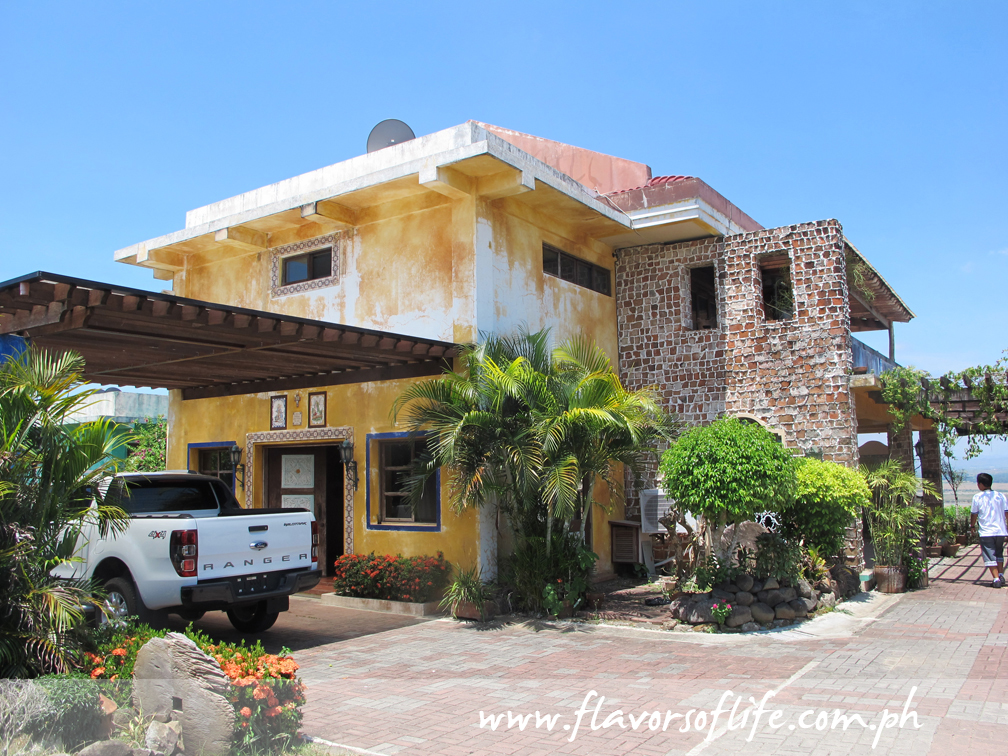
The resthouse/ranch of Congressman Rodito (representing the First District of Isabela) sat atop a sprawling hilly property. The main house had a Mediterranean look and feel to it, while around it stood a native pavilion and an interesting cogon-covered igloo-like hut. Standing on the spacious porch at the back of the house, one could see a breath-taking view of the Cordillera Mountain Ranges to the West and the Sierra Madre Mountain Ranges to the east, with Cagayan Valley in full view before them. San Pablo stood very close to Tuguegarao, Cagayan, so it was quite a ride from Cauayan City, but the view and the food that was to come a bit later were worth it.
Congressman Rodito Albano III’s resthouse/ranch in Ballacayo,San Pablo, Isabela
The airy and colorful resthouse of Congressman Rodito Albano III
The Mediterranean-inspired interiors of the resthouse/ranch
The porch opens up to a breath-taking view of the Cordillera Mountain Ranges to the West and the Sierra Madre Mountain Ranges to the East and the Cagayan Valley right in front
Another corner of the porch with a picturesque view
View from the second floor window…
Pancit Cabagan
Congressman Rodito’s staff went to work, and one of them, Martell Angoluan, conducted an impromptu cooking demo on how to prepare the Albanos’ famous Pancit Cabagan, and the group recorded it step by step. Pancit Cabagan is very similar to the traditional Pancit Canton, although it makes use of a special miki noodle manufactured locally. The noodle dish was cooked with chopped garlic, onion, pork precooked in soy sauce, fish sauce, soup stock, carrot strips and shredded cabbage. Then it was topped with chopped lechon kawali for extra flavour, texture and crunch, and boiled quail and chicken eggs. It’s best eaten with a Pinakurat suka (vinegar) and calamansi juice dip on the side.
Adobo
Crispy Fried Tilapia
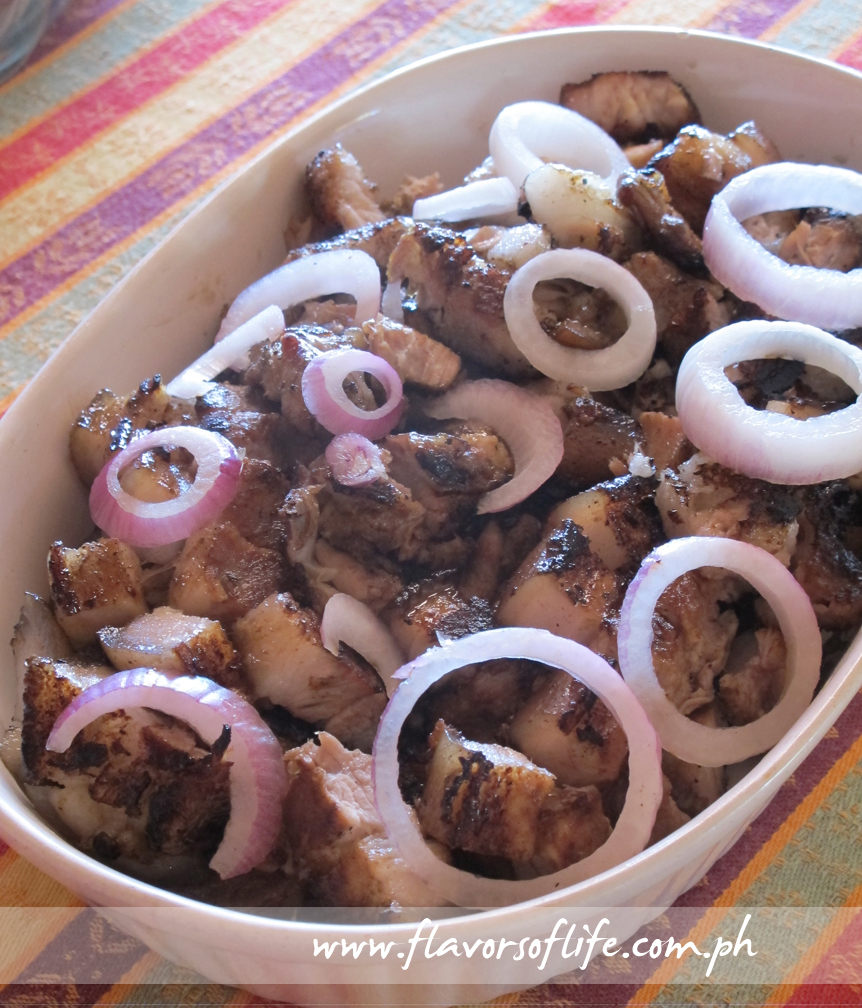
Inihaw na Baboy
After the demo, it was time for lunch, which had everyone feasting on not just the Pancit Cabagan but also on Adobo Isabelleno, Crispy Fried Tilapia (St. Peter’s fish) and Inihaw na Baboy (grilled pork) by the scenic porch.
TWO HISTORIC CHURCHES
From Congressman Rodito Albano III’s place in San Pablo, the group made quick stops at two historic churches, the Roman Catholic Church of San Pablo, Isabela, and the Church of Tumauini near Ilagan City.
The Roman Catholic Church of San Pablo
Built in 1624, the Roman Catholic Church of San Pablo is the oldest church in Isabela, and its bell tower is the tallest in Cagayan Valley.
The Church of Tumauini
The Church of Tumauini was dedicated to patron saint San Matias in 1707 and became a regular parish in 1751. The church of stone with a unique cylindrical bell tower is the only one of its kind in the Philippines. It was partly damaged during World War II and was rebuilt by the faithful of Tumauini. It is now a National Historical Landmark.
KAKANINS GALORE!
From historical churches, our Isabela food tour took us to Ilagan City to get up close and personal with some of the famous kakanins (native delicacies) of Isabela. We dropped in on Felicidad Baggo’s home, whose backyard served as the family’s kakanin-making facility. We caught them making Binallay, Inatata and Bibingkang Kanin.
Cooking kakanins…
Bibingkang Kanin
While Bibingkang Kanin turned out to be familiar to everyone, Binallay and Inatata took a little time to get to know. Both are types of suman, or glutinous rice rolls wrapped in banana leaves then cooked in steamers until done.
Binallay
Aling Felicidad Baggo demonstrating how to mix ground glutinous rice and water to make a dough for the Binallay
Making balls of dough
Wrapping balls of glutinous dough in banana leaves
Steaming is the final step in making Binallay
Binallay with laro
Binallay is pure ground glutinous rice mixed with water, soaked for two hours, kneaded into small balls like siopao, wrapped in banana leaves into slightly flat, rectangular sumans, then steamed until done. Aling Felicidad said Binallay is eaten with laro, or a sweet latik sauce. She also showed us the proper way to eat it, which was to spread laro on a small plate, then tearing the banana leaf covering the Binallay in small strips one at a time, then laying the Binallay on the laro and getting forkfuls of it.
Inatata
Inatata unwrapped!
Inatata is also a type of suman made from cooked whole glutinous rice, lightly sweetened, and then wrapped in banana leaves into small cylinders before being steamed. The curious thing about the Inatata is that, since they are small, they are tied into batches of 10 like ammunition belts of a machine gun.
Aling Felicidad sells her Binallay with a little plastic pouch of laro at Php10 per piece and her Inatata at Php25 per batch of 10, while each round pan of Bibingkang Kanin goes for Php160.
SEAFOOD AND ‘CARNERO’ DINNER
It was already dark by the time the group got back to the Governor’s Mansion in Ilagan City. We slipped into our rooms to wash up and get ready for dinner upon arrival, and then, after a few minutes, trickled out one by one to take a peek at the dinner prep work going on in the kitchen. We were having our dinner in the spacious dining room at the Governor’s Mansion enclosed by glass walls and doors.
I looked forward to dinner because it was a seafood dinner featuring the fresh , shellfish and fish of the coastal town of Palanan, Isabela.
Jeremiah ‘Maya’ Aggabao
By the time we got to the kitchen, Jeremiah ‘Maya’ Aggabao, the special cook of the Mayor of Palanan, was already prepping up the Binagen lobsters and Curacha. He was making Kiko’s Stew, a special soup dish with whole baby lobsters, Maya-Maya and Blue Marlin fish and squid cooked in fresh coconut water. The lobsters and Curacha were so plentiful that Maya decide to also make Steamed Lobsters, for which Angelo Comsti from our group made a delicious garlic butter sauce. Maya said he was also going to cook Dinengdeng for dinner so we would have vegetables to go with the seafood, while Kiko presented his family’s heirloom dish, Tim, a steamed egg dish topped with fried garlic.
Binagen lobster and Curacha from the coastal town of Palanan in Isabela
Kiko’s Stew by Maya Aggabao of Palanan
Dinengdeng
Isabela’s Master Kusinero grand champion, Jay ‘Venus’ Castaneda, who had prepared our dinner on our first night in Isabela, was also around. This time, he had prepared a dessert, Rabong Corn Bibingka, a biko-type rice cake made from ground glutinous rice with labong (called rabong in Isabela, and referred to young bamboo shoots) and corn kernels. To remove the hint of bitterness from the labong, he had boiled it and then squeezed out its juice and then added sugar into it.
Rabong Corn Bibingka by Jay ‘Venus’ Castaneda
Lechon Carnero
The Lechon Carnero (lamb lechon) that Kiko had ordered from Michael Marcelo from San Felipe, Isabela, had also already arrived. It’s one of the celebration dishes that the province of Isabela was truly proud of, and Kiko wanted the group to have a good taste of it. The whole Lechon Carnero was overwhelming, as it slowly came into view when Kiko removed the covering around it. He had the meat carved and chopped for everyone to enjoy as pica-pica before dinner.
While Maya was still busy cooking, Kiko and his business partner Jessica Gallegos asked the group if we wanted to take a short leisurely walk outside. They wanted us to see the Isabela Park that had been recently built right in front of the Provincial Capitol of Isabela. We all said yes, so we took a walk over to the park and marveled at the grand fountain, which had Queen Isabela at the center and all around it characters depicting important moments in the history of the province.
Isabela Park in the evening
The grand fountain with Queen Isabela in the center
We took some photos, sent Paul’s drone up into the dark night sky and watched it hover up there for a while, and then started walking back to the Governor’s Mansion for dinner. The food was ready, and so we sat down for a long, leisurely dinner with Kiko and Jessica, feasting on the lobsters like there’s no tomorrow. In Manila, it’s seldom to see such plentiful lobsters laid out before you, and even if you see such a bounty, it would cost you an arm and a leg to be able to enjoy it.
We did a rundown of the next day’s itinerary before calling it a day. Tomorrow would be another full and flavorful day.
THE first time I ever visited the Northeastern province of Isabela was in January of 2013, when my husband Raff and I joined a busload of Manila-based media to cover Isabela’s colorful and vibrant Bambanti Festival. It became my introduction to the cuisine of Isabela, as the group got to taste a lot of the dishes and native delicacies that locals enjoyed during the four days that we were there. Moriecos, binallay, inatata, the lobsters of Palanan, Pancit Cabagan, longganisa, the tilapia of Magat Dam… They left a ‘delicious’ impression on me.
Last May (2014), Raff and I got to reacquaint our taste buds with the cuisine of Isabela, as we joined a small group of journalists assembled by spot.ph’s Angelo Comsti – the group included Ige Ramos of Bandera and SansRival Magazine, Tata Mapa and Pam Santos of Smile Magazine, Nana Caragay and Paul del Rosario of Turista Magazine – who went on a food tour of Isabela upon the invitation of Francis Faustino ‘Kiko’ Dy, son of Isabela Governor Bojie Dy. Kiko is also barangay captain of San Fabian, Echague, Isabela, and head of all barangay captains in the province.
Arriving via the Tuguegarao Airport in neighboring Cagayan, our service van for the duration of our stay in Isabela took us straight to the residence of Governor Dy in Cauayan City. The First Couple of Isabela was out of the country at that time, but Kiko and his business partner Jessica Gallegos were there to welcome us. It was already late afternoon, and early dinner was going to be in the Governor’s house.
Kiko Dy, son of Isabela Governor Bojie Dy and barangay captain of San Fabian, Echague, Isabela, with business partner Jessica Gallegos
Instead of relaxing in the living room while dinner was being prepared, the group decided to head for the kitchen, where we found Barangay Captain Rodolfo dela Cruz of Barangay Nagcampegan of Cauayan City cooking his signature Siniwsiwan. A variation of the classic Filipino blood stew Dinuguan, Siniwsiwan was a creation of the barangay captain using the freshly drained blood of native chicken, whose innards are also used as a main ingredient in combination with vinegar, shallots, ginger, water and chopped spring onion.
Barangay Captain Rodolfo dela Cruz cooking Siniwsiwan
Siniwsiwan
What makes Siniwsiwan different is that the chicken blood is drained straight into a bowl with half a bottle of local vinegar. This is set aside for the moment, while Captain Rodolfo sautees the chicken innards with shallots and spring onion over low heat. Then the blood with vinegar is added in, plus water, if needed, and then seasoned to taste.
Also in the kitchen was Jay ‘Venus’ Castaneda, a fresh graduate of a technical teacher education course at the Isabela State University and grand champion of the recently concluded Isabela’s Master Kusinero cooking competition. The cooking competition went through a gruelling elimination round by district (it drew participants from 16 districts in Isabela), challenging the participants to whip up delicious dishes using ingredients given them at the last minute – Market Basket style – before entering the grand finals, where 19-year-old Jay prevailed. For bagging the championship, he took home a cash prize of Php100,000 and a culinary scholarship in Manila.
Isabela’s Master Kusinero grand champion Jay ‘Venus’ Castaneda
Queen Isabela’s Treasure by Jay Castaneda
Malongga
Stuffed Finana
Adobo Isabelleno
Tinola
Isabela’s Master Kusinero showed us his mettle by recreating two of the dishes that helped him win the championship – Queen Isabela’s Treasure, a tilapia roulade, stuffed with a red rice and tilapia filling, wrapped with bacon, then breaded and deep-fried to golden perfection; and Malongga, a mixture of Isabela longganisa with grated corn, wrapped in banana leaves and deep-fried, and named after the Tagalog words mais (corn) and longganisa (meat sausage), the two main ingredients of the dish.
Jay also made Stuffed Finana, which is saba (plantain) bananas stuffed with a flaked tilapia and ground munggo (mung beans) filling; as well as Adobo Isabelleno, pork cooked in gata (coconut milk) with samak vinegar. Samak vinegar, explains Jay, was the result of a vinegar-making experiment that they conducted in school using leaves from the samak tree, which can be found in bountiful quantity in Isabela.
A huge bowl of Tinola also made it to the dinner table afterwards. It was made using the four native chickens whose blood and innards Captain Rodolfo dela Cruz used to make his famous Siniwsiwan. The kitchen staff of Governor Dy had browned the roughly sliced ginger in a little oil, added garlic and onion and continued to saute a little longer, then put in the cut-up native chicken and cooked them in just enough water until tender. Lightly seasoned only, the Tinola turned out to be really good, the freshness of the chicken coming out and the ginger-y soup rounding out the comforting flavors.
The Governor’s Mansion in Ilagan City stands right beside the Provincial Capitol of Isabela
Everyone had their fill for early dinner, after which we did a run-down of the following day’s itinerary and, realizing that a long and full day lay ahead, we boarded the van soon after dinner and it took us to the Governor’s Mansion in Ilagan City. The Governor’s Mansion, which stood right behind the Provincial Capitol of Isabela and the sprawling Plaza Isabela in front of it, was to be our home for the next few days. A receiving place for guests of the Provincial Government, the Governor’s Mansion had a pocket garden in the middle and was surrounded by receiving rooms, dining rooms and guest rooms equipped with their own toilet-baths. Jessica assisted us with our room assignments, and we all retired early for the night – looking forward to a whole day of ‘discovering’ the culinary gems of Isabela the next day.