Braised “E-fu” Noodles with Mushrooms
(Chef Sam Leong)

Originally posted on May 24, 2012

Chef Sam Leong’s Braised “E-fu” Noodles with Mushrooms

THE first time I heard about Chef Sam Leong was when I attended the 2006 World Gourmet Summit in Singapore upon the invitation of the Singapore Tourism Board (STB) Philippines, then headed by indefatigable Rocson Chang. Chef Sam Leong, a big name in Singapore, was one of the featured Master Chefs. The small media group from Manila wasn’t able to attend his dinner, as it was held outside of the four days that we were in the Lion City, but his name and his stature as a chef stuck with me. He was one of only a few Asian chefs featured in the gastronomic event, and I could imagine how good he must be to be lined up with some of the best chefs in the world.

Singapore’s most celebrated chef, Sam Leong, conducting a Master Chef cooking class at Makati Shangri-La’s Shang Palace

Last year, I finally got to meet Singapore’s most celebrated chef, Sam Leong, not in Singapore but right here in Manila, when he had a Master Chef stint with Makati Shangri-La Hotel. I didn’t get to attend his cooking class, but I got to attend the first of his two-night dinners, and it was one of the best Chinese meals I’ve ever tasted in my life. That – considering that I’ve been in the food business for more than 10 years now, and I’ve been treated to quite a number of luxurious dinners all these years. His food is different. It’s unique in the sense that it’s Chinese, alright, but there’s a certain twist to it. He shows deep knowledge in the techniques used in Chinese cooking, and yet his food didn’t taste like ordinary Chinese food. He capitalizes on freshness and on the natural flavors of his ingredients, and he somehow has this ability to bring out the natural essence of the ingredients that he uses. His food is simple, uncomplicated, and yet divine.

So, when Makati Shangri-La Hotel’s super-efficient PR and communications team, led by Erica Sotto and Mica Siquijor, announced that Chef Sam Leong is back and he’s holding a Master Chef cooking class cum lunch May 24, 2012, I dropped everything and attended his class. At an hour when the whole nation was glued to their television sets watching the American Idol finale and waiting to see if our very own Jessica Sanchez would become the first Asian to be named American Idol (I still believe she’s the one who deserves to win!), only Chef Sam Leong could extricate me from in front of the television set and make me head for Makati early this morning.

No regrets. There was no dull moment, as Chef Sam Leong conducted his cooking class at the Shang Palace of Makati Shangri-La Hotel like a true pro, explaining procedures, proceeding with his demo in a very organized manner, telling stories animatedly as though he’s simply engaged in a conversation with friends, and sharing cooking tips that some chefs would rather keep to themselves. He made three dishes – Double Boiled Morel Mushrooms, Dried Conpoy and Chicken Consommé; Baked Honey Cod Fish; and Braised “E-fu” Noodles with Mushroom – which were also served for lunch. The recipe of the Braised “E-fu” Noodles with Mushroom, I will share with you, complete with tips and ingredient substitutes that Chef Sam Leong shared with the class.

BRAISED “E-FU” NOODLES WITH MUSHROOMS

1 pack E-fu noodles
12 pcs. straw mushrooms, canned or fresh, cut into halves
100 grams yellow chives or spring onion
1 tsp. dry sole fish powder or minced garlic
chicken stock or consommé
4 tsps. oyster sauce
½ tsp. sugar
¼ tsp. sesame oil
dash of ground white pepper
dark soy sauce for color
spring onion for garnish

1. Poach noodles in a little water until soft. Pour out water.
2. Heat wok with a little oil, add dry sole fish powder or minced garlic, and sauté over medium heat until fragrant. Add straw mushrooms.
3. Pour in just enough chicken stock to make a batch of good braised noodles. Season with oyster sauce, 2 tsps. at a time, sugar (to balance the flavor), sesame oil and ground white pepper, before adding the poached noodles. Braise for about 5 minutes or until sauce becomes thick.
4. Add in a little dark soy sauce until desired color is achieved.
5. Add in yellow chives or spring onion. Mix well.
6. Just before plating, drizzle noodles with a little oil and stir to give the noodles an appetizing sheen.
7. Plate and serve.

Serves 4.
Posted in Pasta/Noodles, Recipes Tagged , , , , , ,

Culinaria Capampangan
Features Chef Sau Del Rosario

Originally posted on May 14, 2012.

Renowned chef Sau del Rosario with Atching Lilian Borromeo in a demo on how to make San Nicolas Cookies

ONGOING at Diamond Hotel Philippines’ premier dining destination Corniche until May 19, 2012, is Culinaria Capampangan, a Capampangan food festival featuring the dishes of renowned celebrity chef Sau Del Rosario.

Chef Sau hails from Pampanga, which is considered as the Culinary Capital of the Philippines. Proud of his heritage, he serves Capampangan food in his critically acclaimed restaurant, Villa Café, where he gives traditional Capampangan dishes a contemporary and gourmet twist. For one, he turns Pampanga’s exotic crickets, called camaru, into chic Camaru and Vegetable Springrolls. He serves his kilawin with pomelo segments in shotglasses, calling it a hip Ceviche with Pomelo, and serves his buro (fermented rice) not just with fried fish and mustasa but with crunchy Fried Catfish Fillet. Look how he elevates other common dishes into gourmet delights, including Pork Sisig with Foie Gras and Organic Egg, Lamb Chops Kaldereta with Local Vegetable Ratatouille, U.S. Sirloin Bistek with Shiitake Confits, Crispy Pata Kare-kare with Steamed Local Vegetables, and Whole Baby Lechon with, no, not the usual paella but with Curried Rice or Biringhe. On opening day, guests were raving about Chef Sau’s Pork Sisig, Lamb Kaldereta, Sirloin Bistek and Crispy Pata Kare-kare– and for a good reason.

Even his desserts, which are the highlight of the dessert buffet of Corniche during the Culinaria Capampangan run, feature very interesting twists. Chef Sau has Brazo de Maiz on dessert glasses instead of the usual Brazo de Mercedes in slices. He serves his halayang ube with pineapple and mango topping in Jaleya Ube with Piña and Mango. Then he has Tibok-tibok, Plantanilla and Suspiros de Macapuno to go with the quintessential Halo-halo.

Other interesting finds on the buffet spreads include an Adobo, Quesong Puti and Salted Egg Pizza, Lemongrass Escargot with Puff Pastry appetizer, Bulanglang Salmon Belly soup, Duck Adobo with Boiled Egg, Crispy Pata Kaldereta and Gule Marangle (pinakbet with lechon and prawns). Everything on the Culinaria Capampangan spread is so characteristic of Chef Sau, who’s fearless when it comes to flavor innovations.

San Nicolas Cookies

The star of TV’s Sarap to Heart, Chef Sau was born and raised in Pampanga, which is considered as the Culinary Capital of the Philippines. After his hotel management degree from UP Diliman, he took his professional culinary training in Nice, South of France, under the guidance of Michelin chef Christian Plumail of Restaurant L’univers. He then worked in the prestigious three Michelin Restaurant Le Divellec in Paris the following year before moving to China to open Luna in Shanghai. Two years later, he became Chef de Cuisine of the famous Raffles Chain’s Equinox in Singapore. He came home in 2005 to open M Café and Chelsea, and later on helped launch Le Bistro Vert and Toro. Now, he proudly owns and runs Villa Café, whose menu shows Chef Sau’s Capampangan heritage and culinary creativity.

During opening day, Chef Sau featured another Capampangan culinary icon, Atching Lilian Borromeo, in a short but informative demo on how to make San Nicolas Cookies using original wooden molds. San Nicolas Cookies are an ‘invention’ of Augustinian friars back when egg whites were used in the construction of churches and egg yolks were being thrown away. To put those egg yolks to good use, San Nicolas Cookies came to be. These arrowroot cookies are special because they bear the image of San Nicolas, whose Feast Day is on September 10, using antique wooden molds. Today, only Atching Lilian Borromeo makes these cookies, and, so, culinary tours in Pampanga make regular stops at her place in Mexico, Pampanga, where she gamely does demos of San Nicolas Cookies.

Catch Chef Sau at Diamond Hotel Philippines’ Corniche. The Culinaria Capampangan foodfest runs until May 19, 2012. Buffet price is P1,600++ nett per person. For inquiries or reservations, call 528-3000 local 1121.

Posted in FoodBiz Tagged , , , , , ,

A Unique Way to Say ‘I Love You, Mom!’

Originally posted on April 26, 2012.

Toblerone’s special Mother’s Day edition chocolate bars

IF you find it difficult to say ‘I love you, Mom,’ but want to say it from the heart, Toblerone, a chocolate brand known for its three-sided chocolate bar which most of us grew up with, has come up with a unique way to help you tell your mother exactly how you feel this Mother’s Day. Simply hand Mom that famous chocolate bar with the words ‘I Love Mom,’ ‘Sweetest Mom’ or ‘Best Mom Ever’ printed on one side of the box and insert your favorite photo with your mom in the heart-shaped photo slot provided, and there’ll be no need for words for your Mom to know exactly what you’re trying to say.

This special Mother’s Day edition of Toblerone chocolate bars, which comes in Dark Chocolate, Milk Chocolate and White Chocolate variants, was launched in stylish fashion over lunch in South Forbes, Makati City, today, with well-known personalities Tessa Prieto-Valdes and RJ Ledesma hosting. The occasion also served as a venue for Toblerone to focus on the importance of a beautiful mother-and-child relationship, as it brought certified life coach and relationships expert Pia Acevedo of the Love Institute to discuss why some young professionals find it difficult to express affection to their moms. She had with her notable young professionals Jessica Tan Gan, RJ Jacinto and Georgia Schultze-Del Rosario discussing how they show their own affection to their respective moms. It was a touching moment when, towards the end of the discussion, their moms showed up and joined them in the informal discussion panel and exchanged words of affection with them.

The discussion panel, from left: life coach Pia Acevedo, Ces and Georgia Schultze, Frannie and RJ Jacinto, Lulu and Jessica Tan Gan, Fortune and RJ Ledesma, and Tessa Prieto-Valdes

Also launched during the luncheon affair was Toblerone’s online promo for Mother’s Day, a photo contest that will allow everyone interested the opportunity to tell the world how much he (or she) loves his mom. Ongoing until May 18, the online promo is giving 50 weekly winners a 100-gram Toblerone bar each, major weekly winners an overnight stay for 2 at Edsa Shangri-La Hotel, and the grand winner an overnight stay for 4 in an Aquarium Room at Hotel H2O complete with spa, breakfast, lunch and dinner. Simply “like” the Facebook Page called “TobleronePilipinas” and upload the sweetest photo of you and your mom together. That photo can be recent or from way back when.

Photos will be judged for the sweetness shown between mom and child, for the creative captions that come with them, and the number of likes that the photos will receive. For more information, you can visit a Toblerone booth in your local mall or grocery, log on to www.givetoblerone.com, or call Toblerone Customer Hotline no. 820-2866.

Posted in FoodBiz Tagged ,

Tom Yam Goong

Originally posted on April 25, 2012

AzuThai’s Tom Yam Goong

TOM Yam Goong is one of the first Thai dishes that I learned to love. Right on my first visit to Thailand, on a culinary tour of Bangkok and Pattaya with Tourism Authority of Thailand (TAT) Philippines’ marketing representative Dave de Jesus and a few colleagues in media, I tasted authentic Tom Yam Goong, which is Hot and Sour Prawn Soup with Lemongrass, Kaffir Lime Leaves and Fresh Coriander, and felt an instant affinity. It’s because, as lovers of Thai food know, Tom Yam Goong is very similar to our own Sinigang na Hipon or Sugpo. In both soup dishes, the flavors of sweet and sour are in a constant tug-o-war, not of the negative kind, but the flavors kind of meld together very harmoniously to achieve a unique flavor profile. The stark difference between Tom Yam Goong and Sinigang comes from the use of lemongrass, Kaffir lime and coriander in Tom Yam Goong. These staples in Thai cooking make Tom Yam Goong very Thai.

Time was when it was difficult to source Kaffir lime leaves in the Philippines, but now the major supermarkets carry them in the fresh herbs section, and even galangal, which is a kind of ginger with a distinct taste that Thais love to use in their cooking, is readily available – on instances when the major supermarkets don’t have it, the bagsakan markets, such as Farmers Market in Cubao, definitely have it.

Chef J Gamboa and AzuThai’s Chef Watee

Recently, when my husband Raff and I visited the 4th Thailand Trade Exhibition at the SMX Convention Center, I was pleasantly surprised to bump into Chef J Gamboa of El Cirkulo, Milkyway, Tsukiji and AzuThai while checking out some bottled Thai sauces in a booth. He said that AzuThai was going to conduct a cooking demonstration a few minutes later, so could we stick around? So we, of course, did. Chef J is not only a good friend and a great chef; AzuThai also happens to be one of the best Thai specialty restaurants in town. Learning a recipe or two from AzuThai definitely wouldn’t hurt!

So we waited for Chef J Gamboa to take center stage with AzuThai’s authentic Thai chef, whom Chef J fondly calls Chef Watee, and, together, they whipped up two Thai recipes that are the most absolute favorites of Pinoys – Tom Yam Goong and Pad Thai – with Chef Watee doing the actual cooking and Chef J annotating. I shall be sharing the recipe of the Pad Thai later on, since it’s another big favorite of mine, but now, please enjoy the recipe of Tom Yam Goong. It cannot get any more authentic than this.

2-1/2 cups shrimp stock
1 cup button mushrooms, quartered
4 pcs. oyster mushrooms
1 pc. Kaffir lime leaf, torn
2 pcs. lemongrass, 4 inches long, bruised by pounding
3 slices galangal, about 1/3-inch thick
3 tbsps. Thai fish sauce
3 tbsps. dayap, calamansi or lemon juice
1-1/2 tbsps. Nam Prik Pao (Thai chili paste)
1-1/2 pcs. tomatoes, quartered
3 pcs. prawns, split
1/4 cup fresh coriander leaves

1. Pour shrimp stock into a stockpot. Bring to a boil.
2. Add mushrooms, Kaffir lime leaf, lemongrass and galangal. Simmer for 5 minutes.
3. Add fish sauce, dayap juice, Thai chili paste, tomatoes and prawns.
4. When prawns are cooked in about 1 minute, ladle into bowls, top with fresh coriander leaves, and serve.

(AzuThai can be found at the Milkyway Bldg., 900 A. Arnaiz Ave. cor. Paseo de Roxas, Makati City. Contact numbers are 817-6252 and 813-0671.)

Posted in Recipes, Soups Tagged , , , , , ,

Pineapple Glazed Oven Roasted Rack of Lamb
(Chef Norbert Gandler)

Originally posted on April 18, 2012.

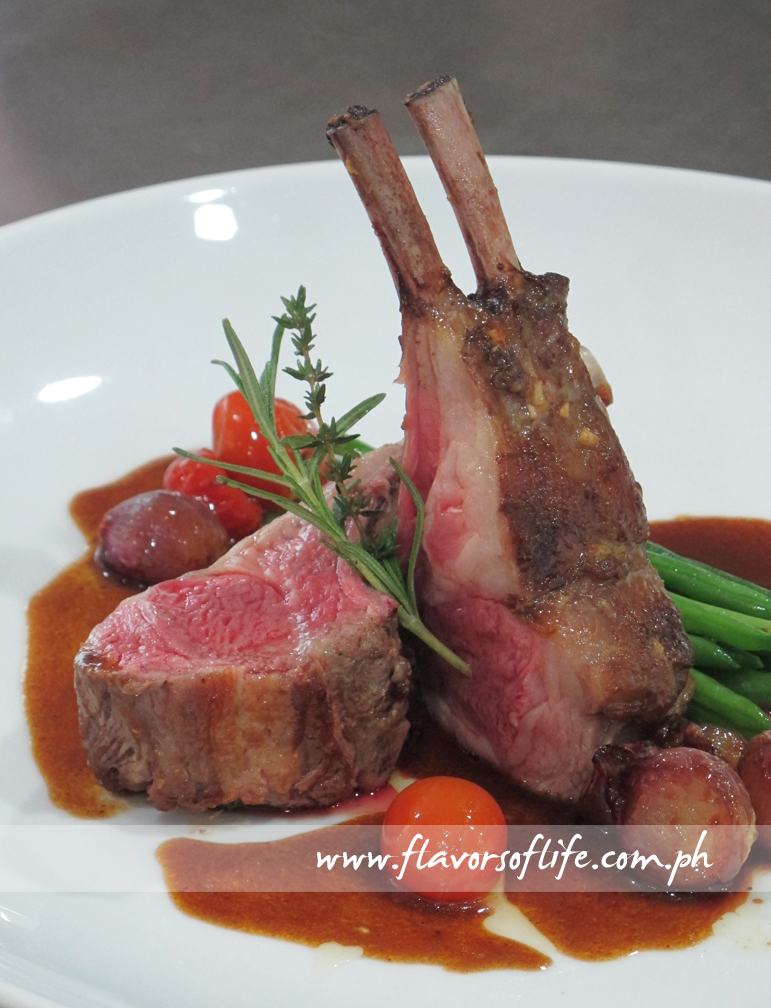
Chef Norbert Gandler’s Pineapple Glazed Oven Roasted Rack of Lamb

WE Filipinos are just beginning to appreciate lamb. Time was when literally nobody was touching lamb, nobody was ordering lamb even in restaurants that offered it, simply because the lamb that we knew back then was actually mutton, or old lamb, which obviously had a maanggo taste and smell to it. But now that the local culinary scene is vibrant and every imaginable ingredient that we had difficulty sourcing before is now readily available, what importers are bringing in are good-quality young lamb meat that no longer has that maanggo taste and smell. So, now, we are beginning to appreciate lamb, which is actually a leaner and healthier type of meat to indulge in, and lamb dishes on restaurant menus are now moving as fast as fish, seafood, beef, chicken and pork dishes.

More so if the lamb is cooked into a delicious concoction like the Pineapple Glazed Oven Roasted Rack of Lamb prepared by celebrity chef Norbert Gandler in a cooking demonstration which he conducted during the media launch of the International School of Culinary Arts and Hospitality Management (ISCAHM) Makati yesterday.

Chef Norbert used a frenched Australian rack of lamb (*frenched means that the ribs have been cleaned or the meat has been trimmed from the end of the rib), and he had the rack seared in a pan with a little olive oil before roasting it in the oven. Searing, he stressed, is important because it locks in the juices of the meat. It’s also important to start the roasting at a high temperature of about 220° and then, after 10 to 15 minutes of roasting, lower the temperature to 180° and then maintain it until the meat is cooked to desired doneness. In the case of lamb, medium is ideal. But, Chef Norbert explains, “it’s important to let the meat rest for about 10 minutes after cooking to ensure maximum tenderness and to prevent the loss of meat juices. Then you can slice or carve it. If you slice it right after the meat comes out of the oven, the juices will all come out and then meat will become dry.”

Chef Norbert served his roast rack of lamb with Port Wine Sauce, Cherry Tomato Confit and Braised Shallots, and garnished it with fresh sprigs of rosemary and thyme to make a dish that tastes as good as it looks and looks as good as it tastes.

Here’s the recipe:

THE LAMB:
1.2 kgs. rack of lamb, Australian, Frenched
iodized salt and freshly crushed black pepper
60 ml. olive oil
30 grams mustard
50 grams minced garlic
10 grams fresh rosemary or thyme, removed from stem

THE GLAZE:
500 ml. pineapple juice
50 grams butter

1. Trim the rack of lamb if it hasn’t been Frenched. Marinate with olive oil, mustard rosemary or thyme, and garlic. Just before searing the lamb, season with salt and pepper.
2. Place pineapple juice and butter in a saucepan, and reduce by half.
3. In a hot pan, sear rack of lamb with a little oil. Then invert and sear the other side. Finish roasting in the oven at around 180° until desired doneness is achieved. (*If roasting a whole rack of beef, it’s ideal to roast initially at 220° and then lower the temperature to 180° until the roast is done.)
4. When the lamb is cooked, let it rest for about 10 minutes before carving.
5. Before serving, glaze the lamb with pineapple glaze.

THE CHERRY TOMATO CONFIT:
4 pcs. cherry tomatoes
5 grams thyme
10 grams garlic
250 ml. olive oil
salt and black pepper to taste

1. Wash and sanitize cherry tomatoes, thyme and garlic.
2. Blanch and peel cherry tomatoes.
3. Slice garlic thinly. Remove thyme from stem.
4. Combine olive oil, garlic and thyme in a saucepot. Bring to a poaching temperature. Add salt and pepper. Poach cherry tomatoes over low heat until cooked.

THE BRAISED SHALLOTS:
900 grams small shallots, peeled
20 grams thyme, removed from stem and chopped coarsely
60 grams white sugar
80 grams unsalted butter
iodized salt as needed
120 ml. red wine
sea salt and ground white pepper to taste

1. Caramelize sugar. Add butter and let it foam.
2. Add shallots, sauté lightly and add season with iodized salt. Sweat the shallots.
3. Deglaze with red wine.
4. Cover and simmer for approximately 12 minutes or until shallots are cooked.
5. Remove cover. Remove shallots and reduce liquid to a syrupy consistency. Then put shallots back into the glace. Season with sea salt and pepper.

THE PORT WINE SAUCE:
50 grams shallots
butter for sautéeing
250 ml. Port wine
1 sprig fresh thyme
700 ml. brown sauce
iodized salt and ground white pepper to taste
40 grams cold butter, cut into nuggets

1. Sauté shallots in a little butter until translucent.
2. Deglaze with Port wine, add fresh thyme and reduce by half.
3. Add brown sauce and simmer until the right consistency is achieved.
4. Strain the sauce.
5. Season to taste. Then monter with cold butter before service. Add cold butter to the sauce after it is cooked gives it additional flavor, thickens the sauce and makes it slightly shiny. The proper way to monter with cold butter is to whisk right away to emulsify the butter and incorporate it into the sauce, otherwise the butter will remain separate.

Posted in Meat, Recipes Tagged , , , , , , ,